IFI 8410: Introduction to Programming and Predictive Analytics for Business
Listen to the introduction
Transcript
| Speaker | Text |
|---|---|
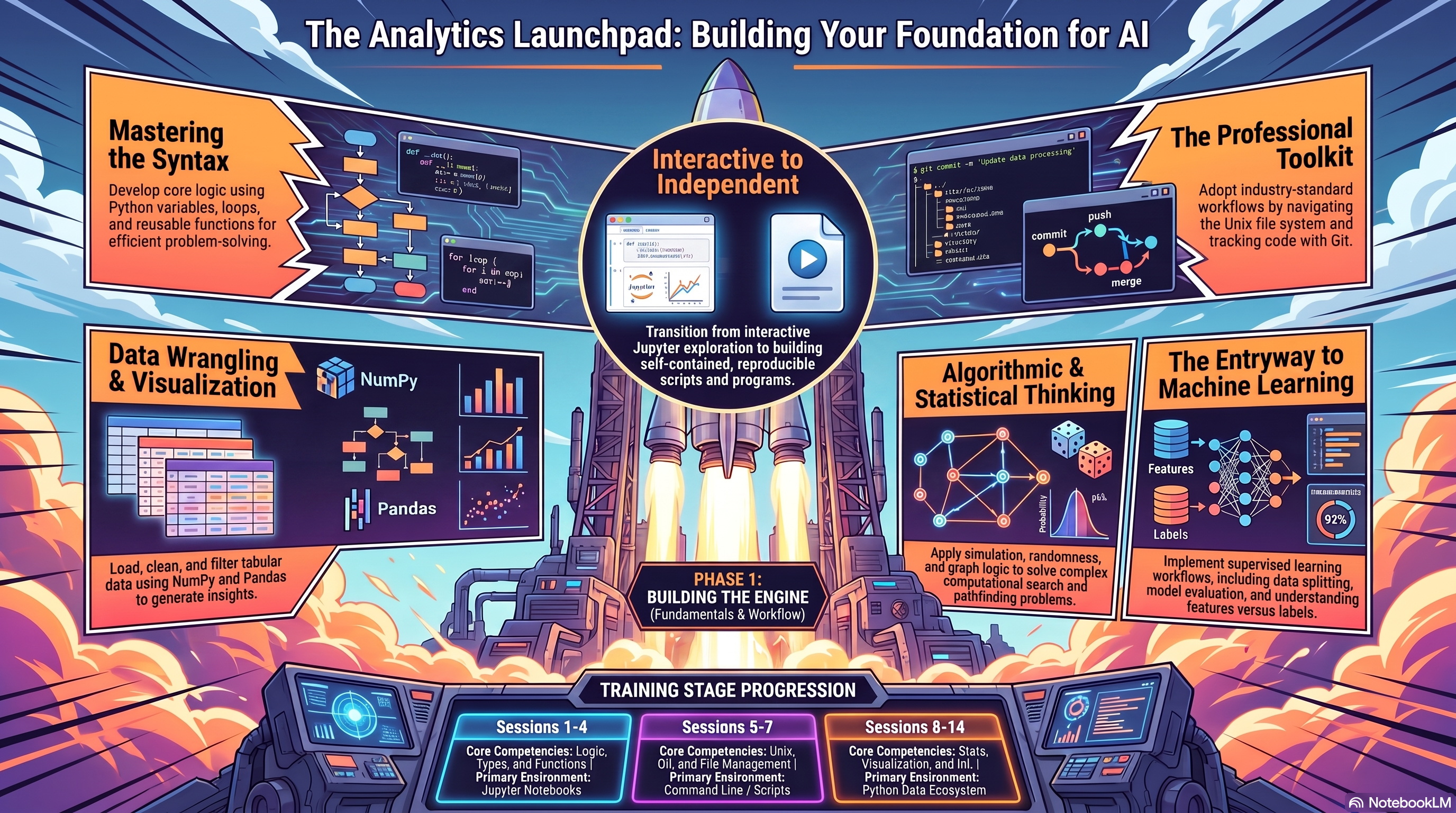
| Alex | This is the brief on Python programming for data analytics. If you’re an incoming grad student, this course is your ultimate zero experience required launchpad into data science and AI. Custom designed to build the exact real world workflows you’re going to need for your degree. First up, we’re focusing on practice over pressure. There are absolutely no exams. Instead, you’ll build your skills through weekly coding practice, automated feedback, and just explaining your work in plain language. We’re going to start you off in interactive Jupiter notebooks. Think of those as your training wheels, which perfectly preps you before hitting the mountain trails of writing your own standalone Python scripts. Second, you’ll master the professional toolkit. So you can write a Python script now, but what happens when you need to manage hundreds of files or track your changes? Let’s be real, raw coding is kind of useless without a solid file management workflow. You’re going to learn the Unix command line to navigate your computer right alongside Git, which is a version control system you’ll use to track your edits and keep your whole process reproducible. Finally, we build your AI and machine learning foundation using heavy hitting analytics libraries like NumPy and Pandas plus core algorithmic thinking. Now, I know everyone wants to jump straight into building fancy AI, but you literally have to master these basics first. We’ll deconstruct how AI actually learns by exploring features and train test data splits, so you intuitively grasp concepts like overfitting before you move on. Ultimately, this class will transform you from a complete coding beginner into someone with the exact foundational habits needed to absolutely crush your future advanced AI coursework. |
IFI 8410 is a first course in programming for business analytics, and assumes no prior experience. It builds from core Python — types, control flow, containers, functions, and files — through the working environment real analysis depends on, the Unix command line, Git, and reproducible scripts, to data work itself: NumPy and pandas, descriptive statistics and visualization, simulation, search and graph algorithms, and a first supervised machine-learning model. Weekly individual assignments build the skills, and a term project applies them end to end to a retail analytics problem on the university’s Analytics Research Cluster.
Schedule
| Session | Date | Topic | In Class | Assignment |
|---|---|---|---|---|
| 1 | 2026-08-26 | Introduction to Python and the Course Environment | ACT01 | |
| 2 | 2026-09-02 | Types, Strings, and Conditionals | ACT02 | HW01 |
| 3 | 2026-09-09 | Loops and Core Data Structures | ACT03 | HW02 |
| 4 | 2026-09-16 | Functions and Decomposition | ACT04 | HW03 |
| 5 | 2026-09-23 | Files, Modules, and Scripts | ACT05 | HW04 |
| 6 | 2026-09-30 | Unix File System and Command Line | ACT06 | HW05 |
| 7 | 2026-10-07 | Git and Reproducible Workflow | ACT07 | HW06 |
| 8 | 2026-10-14 | Python for Data Analysis | ACT08 | HW07 |
| 9 | 2026-10-21 | Visualization and Descriptive Statistics | ACT09 | HW08 |
| 10 | 2026-10-28 | Simulation and Randomness | ACT10 | HW09 |
| 11 | 2026-11-04 | Search and Hashing | ACT11 | HW10 |
| 12 | 2026-11-11 | Graphs and Shortest Path | ACT12 | HW11 |
| 13 | 2026-11-18 | Introductory Machine Learning | ACT13 | HW12 |
| 14 | 2026-12-02 | Integration and Review | ||
| 2026-12-09 | -- no class -- |
Documents
Teaching Assistants, Labs & Office Hours
Visit the class page on iCollege for current information.
Topics
- Introduction to Python and the Course Environment
- Types, Strings, and Conditionals
- Loops and Core Data Structures
- Functions and Decomposition
- Files, Modules, and Scripts
- Unix File System and Command Line
- Git and Reproducible Workflow
- Python for Data Analysis
- Visualization and Descriptive Statistics
- Simulation and Randomness
- Search and Hashing
- Graphs and Shortest Path
- Introductory Machine Learning
- Integration and Review